
Protect Quality and Throughput in Food and Beverage Plants
How plant teams can deploy AI without disrupting validated production and food safety workflows.
This guide helps food and beverage manufacturers prioritize AI use cases that improve quality consistency, OEE, and supply-response speed.
Scenario Metric References
| Metric | Value | Note |
|---|---|---|
| Global market (2024) | $8.2T | |
| 2034 outlook | $14.7T | |
| AI market (2034–2035) | $79–264B | |
| Defect detection accuracy | 90–95%+ | |
| Inline QC latency | <120–200 ms edge inference | |
| Uptime target | 99.5%+ with watchdogs and auto-rollback | |
| Payback | 6–12 month typical for QC / maintenance pilots | |
| Line rejection target | -15% to -30% with tuned inline inspection and root-cause loops | |
| Changeover efficiency target | +8% to +18% via AI-assisted sequencing and setup standardization |
Executive Summary: Food and Beverage Market and AI Opportunity
The global food and beverage market was about $8.2T in 2024 and is projected to reach $14.7T by 2034.
AI in Food & Beverages is much smaller but grows far faster, with reported CAGRs of roughly 12–37% depending on definitions.
Leading plants connect quality, maintenance, and production data into a single operational model to reduce waste and improve yield.
Market size examples
- Precedence: $11.08B in 2024, $263.8B by 2034 (CAGR 37.3%).
- Market Research Future: $22.45B in 2024, $79.05B by 2035 (CAGR 12.1%).
- Technavio: +$32.2B growth by 2029, CAGR 34.5%.
- TowardsFNB: $9.51B in 2025, $90.84B by 2034 (CAGR 28.5%).
Production‑level impact
- Computer vision lifts product/pack/label defect detection to 90–95%+.
- Predictive maintenance can push OEE from 65–72% to 80–88% and cut unplanned downtime up to 70%.
- Process optimization reduces scrap and energy usage by meaningful single‑ to double‑digit ranges.
- Demand forecasting and shelf‑life management lower recall risk and waste.
In food and beverage manufacturing, AI is a strategic lever that improves safety, quality, and efficiency at the same time.
Global Food and Beverage Market Outlook and Demand Drivers
Market size, growth, and sector dynamics at a glance.
1.1 Market size and growth
- 2024 market size around $8.22T; $8.71T in 2025 and $14.72T by 2034 (CAGR ~6%).
- Cognitive and MarketGrowth reports estimate 5–7% growth across 2021–2033.
Sector dynamics
- Population growth and urbanization drive processed and ready‑to‑eat demand.
- Health/wellness and personalized nutrition trends.
- Tighter food safety regulation and traceability requirements.
- Sustainability and carbon footprint pressure across packaging and supply chain.
AI in Food and Beverage: Market Size, Growth, and Adoption
Definitions vary, but all reports confirm AI as a fast‑growing strategic technology area for food manufacturing.
2.1 Market size and segments
- Precedence: $11.08B in 2024, $263.8B by 2034 (CAGR 37.3%).
- Market Research Future: $22.45B in 2024, $79.05B by 2035 (CAGR 12.12%).
- Technavio: +$32.2B growth 2024–2029; CAGR 34.5%.
- TowardsFNB: $9.51B in 2025, $90.84B by 2034 (CAGR 28.5%).
- Precedence notes food manufacturing as the largest end‑user segment in 2024.
2.2 Production‑focused application areas
- Smart quality control and food safety (computer vision, sensors).
- Predictive maintenance and OEE optimization.
- Process optimization (cooking, mixing, fermentation, filling).
- Demand and production planning, inventory optimization.
- Product formulation and new product development (NPD).
- Smart packaging, shelf‑life prediction, traceability.
AI in Food & Beverage is a double‑digit growth market over the next decade.

High-Impact AI Use Cases in Food and Beverage Manufacturing
Quality, maintenance, process, and supply chain applications.
3.1 Food safety and quality control
Manual inspection and sample‑based lab tests are slow and error‑prone.
Computer Vision + ML enables real‑time inspection of every item.
- Defect detection accuracy can reach 90–95%+.
- Foreign objects, fill levels, label defects, and seal issues are captured automatically.
- Automated audit trails improve regulatory compliance.
- Spectral + hyperspectral for contaminants, color drift, moisture and fat estimation.
- Code example (Python): `defects = yolo_model.predict(batch_frames)`.
3.2 Predictive maintenance and OEE optimization
Fillers, pasteurizers, ovens, mixers, and packaging lines run 24/7 with CIP cycles.
AI‑driven maintenance can lift OEE to 80–88% and cut unplanned downtime up to 70%.
- LSTM/GRU/1D‑CNN on sensor signals.
- XGBoost/Random Forest on engineered features.
- Improved spare‑parts planning and maintenance scheduling.
- Inline vibration/current/temperature monitoring on bearings, pumps, and motors.
3.3 Process optimization: cooking, mixing, fermentation, filling
Food processes are multi‑parameter and frequently change format.
AI learns parameter combinations that yield optimal quality and throughput.
- XGBoost/LightGBM/MLP for quality‑yield‑energy modeling.
- Bayesian optimization and genetic algorithms for tuning.
- RL enables adaptive process control over time.
- Multimodal PAT: temperature, pH, Brix, viscosity, acoustic/vibration during mixing/filling.
3.4 Product formulation and NPD
- Taste‑profile and consumer preference models guide reformulation.
- Generative AI suggests new recipes under nutrition/cost constraints.
- Supports sugar/salt reduction without compromising texture.
- Shelf-life impact estimation using time-series spoilage models.
3.5 Supply chain, demand forecasting, shelf life
- LSTM, Prophet, XGBoost, and transformer models improve demand forecasts.
- Short‑shelf‑life products balance waste vs. stock‑out better.
- Smart packaging enables item‑level shelf‑life prediction.
- Cold-chain anomaly detection from temperature/CO₂ loggers.
AI Model Families and Reference Architectures for Food Manufacturing
4.1 Computer vision
- CNN classification: ResNet, EfficientNet, DenseNet, MobileNet.
- Detection: YOLOv5/v8, Faster R‑CNN, RetinaNet.
- Anomaly detection: Autoencoder, Isolation Forest.
- Hyperspectral + 3D vision for contamination and seal integrity.
4.2 Time‑series models
- XGBoost / LightGBM / CatBoost.
- LSTM, GRU, Temporal Fusion Transformer.
- Spectral/fermentation PAT models for inline prediction.
4.3 Tabular/process models
- Gradient boosting and Random Forest.
- MLP models for nonlinear relationships.
- Bayesian optimization + surrogate models for process tuning.
4.4 Optimization and RL
- LP/QP + ML predictors.
- Genetic algorithms and Bayesian optimization.
- RL process control (PPO, DDPG).
- Multi‑objective optimization: quality + energy + throughput.
Quantified Benefit Ranges and KPI Impact
Quality and food safety
- Defect detection accuracy can reach 90–95%+.
- Lower recall risk and fewer missed defects.
- Inline latency <200 ms supports high-speed rejection at 400–800 ppm.
Predictive maintenance and OEE
- OEE can rise from 65–72% to 80–88%.
- Unplanned downtime can drop by up to 70%.
- Maintenance cost reduction 10–25% with condition-based work.
Energy and waste
- Single‑ to double‑digit energy savings in cooking/cooling/storage.
- Lower scrap and rework rates.
- Yield uplift 1–3 pts for thermal and filling processes.
Demand and supply
- 10–30% improvement in forecast error.
- Better shelf‑life management reduces waste.
- On-time delivery uplift 3–6 pts with smarter scheduling.
With the right setup, AI improves cost, quality, and compliance together.
Phased AI Execution Roadmap for Food and Beverage
An actionable roadmap for a typical food and beverage plant.
Phase 1 - Data foundation and baseline KPIs
- Set priorities: food safety, OEE, or waste reduction.
- Inventory SCADA/MES, lab quality data, and maintenance logs.
- Build dashboards for OEE, waste, energy, downtime causes.
- Define defect taxonomies and labeling SOPs for QC datasets.
Phase 2 - Quick-win pilots and validation
- Computer‑vision QC PoC on a critical line.
- Predictive maintenance pilot for 5–10 critical assets.
- Demand forecasting pilot for a short‑shelf‑life product family.
- Shadow mode + HITL sign‑off before automation.
Phase 3 - Scale, integration, and automation
- Roll out QC and maintenance to other lines.
- Deploy process optimization models for cooking/mixing/fermentation.
- Scale smart packaging and shelf‑life projects with retailers.
- Integrate alerts into CMMS/ERP; enable rollback/versioned releases.
Leadership Recommendations and Execution Priorities
- Put AI at the center of food safety and efficiency strategy.
- Start with data visibility before automation and AI.
- Focus on quick wins in quality/safety and predictive maintenance.
- Choose model families by problem: vision = CNN/YOLO, forecasting = XGBoost/LSTM, optimization = GBM + optimization/RL.
- Balance internal capability with transparent external partners.
Sources and Further Reading
8.1 Food & beverage market size
- Precedence Research | Food and Beverages Market Size to Attain USD 14.72 Trillion by 2034https://www.precedenceresearch.com/press-release/food-and-beverages-market-size
- TowardsFNB | Food and Beverages Market Size, Growth, and Trends 2025 to 2034https://www.towardsfnb.com/insights/food-and-beverages-market
- Cognitive Market Research | Food and Beverage Market Reporthttps://www.cognitivemarketresearch.com/food-and-beverage-market-report
- MarketGrowthReports | Food and Beverage Market Size | Global Forecast To 2033https://www.marketgrowthreports.com/market-reports/food-and-beverage-market-112784
- Grand View / Horizon | Food and Beverages – Industry 5.0 Market Outlookhttps://www.grandviewresearch.com/horizon/statistics/industry-5-0-market-outlook/end-use/food-and-beverages/global
8.2 AI in Food & Beverage / Food Manufacturing market
- Precedence Research | AI in Food and Beverages Market Size 2025 to 2034https://www.precedenceresearch.com/ai-in-food-and-beverages-market
- Market Research Future | Artificial Intelligence In Food And Beverages Markethttps://www.marketresearchfuture.com/reports/artificial-intelligence-in-food-and-beverages-market-31826
- Technavio | Artificial Intelligence (AI) in Food and Beverage Industry Market Size 2025–2029https://www.technavio.com/report/artificial-intelligence-market-in-food-and-beverage-industry-analysis
- MarketsandMarkets | AI in Food & Beverage Market – Global Forecast to 2029https://www.marketsandmarkets.com/Market-Reports/ai-in-food-and-beverage-market-249473496.html
- TowardsFNB | AI in Food Manufacturing Market Size to Cross USD 9.51 Billion in 2025https://www.towardsfnb.com/insights/ai-in-food-manufacturing-market
8.3 Food safety and quality control
- Ioni.ai | How AI Is Transforming Food Safety (2025)https://ioni.ai/post/how-ai-is-transforming-food-safety
- Agribusiness Academy | How AI is Transforming Food Safety & Quality Control in 2025https://learning.agribusiness.academy/how-ai-is-transforming-food-safety-quality-control-in-2025/
- ESP JETA | AI Applications in Food Safety and Quality Control (PDF)https://www.espjeta.org/Volume2-Issue3/JETA-V2I3P111.pdf
- ScienceDirect | Research progress on the artificial intelligence applications in food safety (W. Yu, 2024/2025)https://www.sciencedirect.com/science/article/abs/pii/S0924224424005314
8.4 Predictive maintenance, OEE, and Industry 5.0
- Oxmaint | Oxmaint AI for Food Manufacturing Plants: Predictive Maintenance & OEE (2025)https://oxmaint.com/article/oxmaint-ai-food-manufacturing-predictive-maintenance-oee
- Grand View / Horizon | Food and Beverages – Industry 5.0 Market Outlookhttps://www.grandviewresearch.com/horizon/statistics/industry-5-0-market-outlook/end-use/food-and-beverages/global
Additional standards and market references (2024-2026)
- USDA ERS | Processing and marketing (Food manufacturing data)https://www.ers.usda.gov/topics/food-markets-prices/processing-marketing/
- WHO | Global strategy for food safety 2022-2030https://www.who.int/publications/i/item/9789240057685
- FAO | World Food Situation updateshttps://www.fao.org/worldfoodsituation/en/
Governance, MLOps, and Deployment Patterns for Regulated Manufacturing
Food safety use cases require strict governance, HITL controls, and rollbacks to avoid quality or recall risk.
Data quality and labeling
- Defect taxonomies per product/pack format; label QA with inter-rater agreement and periodic audits.
- Traceability for image/time/location/line/batch; versioned datasets for regulators.
HITL and rollout safety
- Shadow mode on live lines with operator confirmation before automatic rejection.
- Thresholds by defect severity; override logs for QA leadership.
Monitoring, drift, and resilience
- Latency/uptime SLOs (<200 ms per inference; 99.5% uptime) with watchdogs and alerting to line supervisors.
- Drift monitoring on color/illumination/product variants; retrain triggers tied to SKU or packaging changes.
Deployment patterns
- Edge inference at camera gateways; cloud/VPC training with PrivateLink; no PII/recipes outside VPC.
- Blue/green deployments for QC models; rollback on FP/FN thresholds; CMMS/SCADA integration for events.
Security and compliance
- GxP/food safety audit trails; signed binaries for edge devices.
- Network segmentation between OT and IT; encryption in transit/at rest; role-based access with audits.
Why Veni AI for Food and Beverage Transformation
Veni AI combines food manufacturing experience with end-to-end delivery: data, labeling QA, evaluation harnesses, secure connectivity, and production-grade MLOps.
What we deliver
- Inline vision stacks for defects/contaminants with <200 ms latency and health checks.
- Predictive maintenance + OEE analytics with condition-based rules feeding CMMS.
- Shelf-life and demand forecasting tuned for short shelf-life SKUs; SKU-aware retraining.
Reliability and governance
- Shadow-mode launch, HITL approvals, rollback/versioning, and release checklists for every line.
- Monitoring of drift, anomaly, latency, and uptime; alerts routed to QA, maintenance, and operations.
Pilot-to-scale playbook
- 8–12 week PoCs on a single line; 6–9 month scale-out across plants with change management and operator training.
- Secure connectivity (VPC, PrivateLink/VPN) and OT isolation; zero secrets in logs; no hardcoded credentials.
Higher food safety, better OEE, and faster payback with governed, reliable AI.
Factory Owner Decision Playbook for Food and Beverage Plants
Decision support for leadership teams evaluating where to start, how to measure value, and how to de-risk rollout.
High-intent search queries this page targets
- AI for food factory quality control
- How to reduce food production waste with machine vision
- Predictive maintenance for beverage bottling lines
- FSMA traceability-ready data architecture for manufacturers
90-day pilot KPI set
- First-pass yield and packaged-product rejection rate.
- OEE delta by line and SKU family.
- Changeover duration and micro-stop frequency.
- Complaint-per-million units and time-to-root-cause.
- Traceability data completeness across CTE/KDE events.
Investment and payback checkpoints
- Start where margin erosion is measurable: giveaway, scrap, downtime, or late-fulfillment penalties.
- Pair each model output with a clear operator action and closed-loop verification.
- Quantify avoided compliance risk with auditable traceability evidence.
- Require post-pilot SOP updates before approving multi-line replication.
For most plants, value appears fastest when one quality KPI and one throughput/cost KPI are governed together under a single pilot owner.
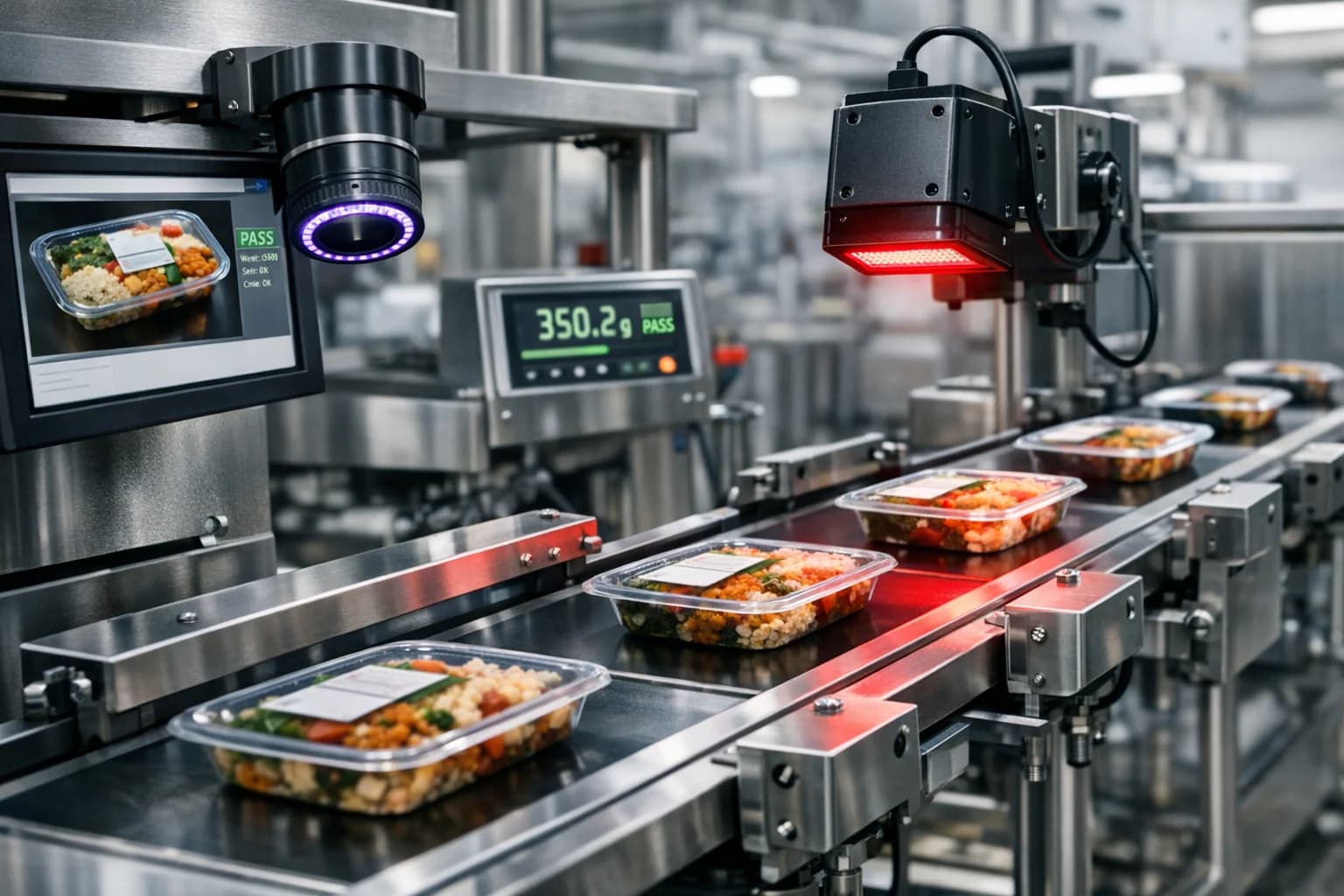
Production Data and Integration Blueprint for Food Manufacturing
Operational architecture required to keep model outputs reliable in production, not just in proof-of-concept environments.
Systems that must be connected first
- MES and line PLC historians for throughput, stops, and quality events.
- Vision systems, checkweighers, and metal detection outputs in unified event schema.
- ERP + planning for batch economics and fulfillment constraints.
- Quality and complaint systems for defect taxonomy and escalation analytics.
- Warehouse and cold-chain telemetry when shelf-life risk drives losses.
Model risk and governance requirements
- Lock critical food safety thresholds and keep human approval for exception handling.
- Track model drift by recipe change, supplier lot, and seasonal demand mix.
- Enforce data lineage for each recommendation used in release or rework decisions.
- Maintain rollback paths for model-assisted routing and inspection rules.
Scale-up criteria before multi-site rollout
- Sustained KPI gains across at least two production campaigns.
- No adverse food safety trend signals during pilot autonomy increase.
- Cross-functional buy-in from QA, production, maintenance, and planning leaders.
- Audit-ready evidence pack for data, model decisions, and corrective actions.
Treat data quality, model lifecycle controls, and operator adoption as one integrated system; scaling only one layer usually destroys ROI.
Want to adapt this scenario to your factory?
Let's collaborate on data readiness, pilot selection, and ROI modeling.