
Reduce Casting Scrap and Stabilize Furnace Output
A practical blueprint for foundries targeting higher quality consistency and better furnace economics.
This scenario supports casting plants that need measurable gains in defect prevention, productivity, and process control maturity.
Scenario Metric References
| Metric | Value | Note |
|---|---|---|
| Global market (2024) | $150–200B | |
| 2032–2035 outlook | $240–450B | |
| Robotics market (2032) | $18.6B | |
| Scrap reduction | 15–30% | |
| Inline QC latency | <150–220 ms for surface/CT inference | |
| Uptime target | 99%+ for inspection/dispatch services | |
| Pilot-to-scale timeline | 8–12 week pilots; 6–9 month line-wide rollout | |
| Scrap and rework target | -10% to -28% on recurring defect families | |
| Furnace energy target | -5% to -14% specific energy with tuned melt and hold strategies |
Executive Summary: Metal Casting Market and AI Opportunity
Global metal casting is roughly $150–200B in 2024, with projections of $240–450B by 2032–2035.
Casting‑robot markets rise from $7.3B in 2024 to $18.6B by 2032 as AI‑driven automation scales.
Scrap rates and energy intensity remain top cost drivers, making AI-driven QC and process optimization high-ROI priorities.
Primary AI impacts
- Quality control: real‑time defect detection cuts scrap by 15–30%.
- Process optimization: tuning temperature and pouring speeds reduces energy and cycle time.
- Predictive maintenance: downtime reductions up to ~30% on critical equipment.
- Digital twins for molding/pouring to de-risk new recipes and gating.
In casting, AI is a strategic requirement to meet tighter quality standards and reduce energy costs.
Global Metal Casting Market Outlook and Demand Drivers
Market size, regional distribution, and macro trends.
1.1 Market size and dynamics
- 2024 market estimates range from $150B to $200B; projections reach $240–450B in the mid‑2030s.
- Asia‑Pacific (China, India) holds ~40–55% share.
Key trends
- Lightweighting: EV‑driven aluminum/magnesium demand and giga‑casting.
- Sustainability: energy‑intensive processes face carbon pressure.
- Foundry 4.0: sensors, robotics, and AI integration.
AI in Metal Casting and Robotics: Market Size, Growth, and Adoption
AI adoption in foundries scales with robotics and automation investment.
2.1 Robotics integration
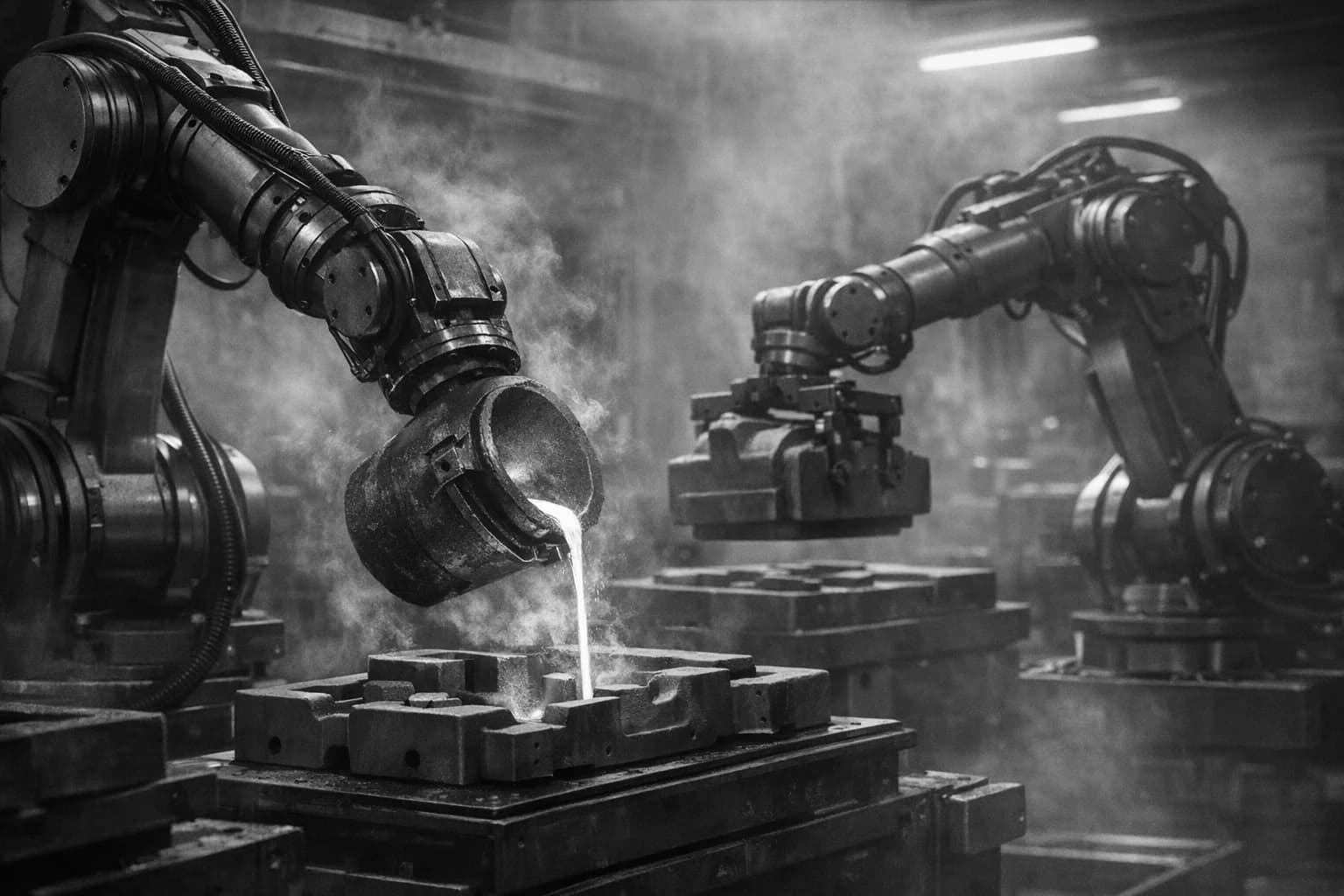
- Casting robots: $7.3B in 2024 → $18.6B by 2032 (CAGR 12.4%).
- AI‑enabled robotic cells minimize pouring waste and monitor thermal behavior.
- Reported throughput gains up to ~25%.
- Vision-guided robots for deburring/finishing with closed-loop QA.
AI + robotics shifts foundries from manual‑intensive to high‑precision production.
Production-Focused AI Use Cases in Foundries
Quality control, process optimization, and predictive maintenance.
3.1 Quality control and defect detection
Porosity, cracks, and shrinkage are hard to detect manually; CT/X‑ray is costly and slow.
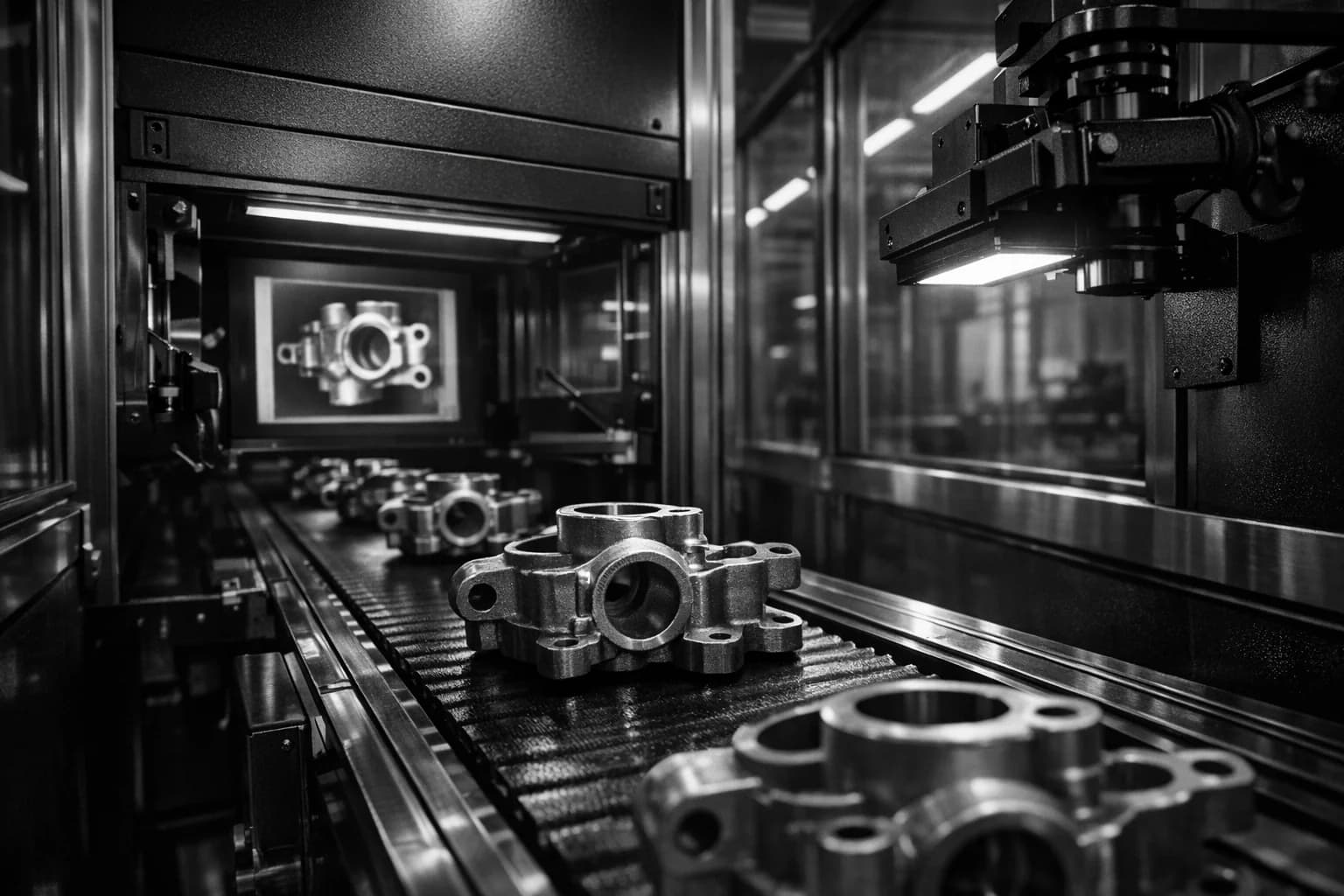
AI enables real‑time surface and internal defect detection.
- Camera + CNN for surface defects.
- AI analysis of X‑ray / ultrasonic data for internal defects.
- Scrap reduction 15–30% and QC cost savings >30%.
- Latency targets <220 ms for inline rejection; FP/FN thresholds tuned to alloy and part criticality.
- Code example (Python): `defect_mask = unet.predict(xray_frame)`.
3.2 Process optimization and digital twin
- Smart pouring optimizes flow, reducing turbulence and air entrapment.
- Digital twins cut setup/parameter tuning time by up to 40%.
- AI‑driven alloy discovery shortens R&D cycles.
- Melt/furnace energy optimization via multivariate models.
3.3 Predictive maintenance
- Sensors on furnaces, presses, and CNCs detect early anomalies.
- Downtime reductions up to ~30% and lower maintenance cost.
- Extended equipment lifetime.
- Edge inference near furnaces/presses; buffered sync to VPC/cloud for training.
Quantified Benefits and KPI Impact
Scrap and quality
- 15–25% scrap reduction with AI‑based QC.
- QC cost reductions of 30%+.
- Inline latency <220 ms supports high-speed rejection.
Energy efficiency
- 10–15% energy savings through furnace and pouring optimization.
- Cycle-time reduction via better thermal control.
Throughput and R&D speed
- Robotic cells can raise throughput by ~25%.
- Alloy discovery timelines drop from years to months.
- Changeover/setup time reduction 20–40% with digital twins.
AI improves cost, quality, and sustainability in energy‑intensive foundries.

Phased AI Execution Roadmap for Metal Casting
A three‑phase roadmap for foundry transformation.
Phase 1 - Digital foundation and data readiness
- Add sensors to critical furnaces, presses, and CNCs.
- Digitize SCADA and quality data.
- Standardize scrap‑reason taxonomy.
- Define defect taxonomies and labeling SOPs for surface/CT datasets.
Phase 2 - Pilot projects and validation
- Visual QC pilot on the highest‑scrap part.
- Process monitoring model linking temperature and speed to quality.
- Predictive maintenance pilot on critical assets.
- Shadow mode + HITL on QC before auto-reject; rollback-ready releases.
Phase 3 - Integration, scale, and automation
- Closed‑loop AI control for robots/press parameters.
- Scale successful solutions across lines.
- Integrate maintenance alerts with CMMS.
- Blue/green deployments for QC and process models with rollback.

Leadership Recommendations and Execution Priorities
- Make scrap reduction the primary AI objective to cut wasted energy.
- Combine robotics with AI for adaptive, vision‑guided cells.
- Prioritize industrial‑grade sensors (IP67+) and data quality.
- Link AI projects to energy and carbon‑reduction goals.
- Start with fast‑ROI pilots and scale systematically.
Sources and Further Reading
Market size
- Market Reports World | Metal Casting Market Size valued at USD 199.86 Billion in 2024
- Market Research Future | Metal Casting Market USD 149.80 Billion in 2024
- Cognitive Market Research | Global Metal Casting market size USD 37.5 billion (CAGR 8.6%)
- Congruence Market Insights | Metal Casting Robots Market USD 7.3 Billion in 2024 (CAGR 12.4%)
Applications and technology
- LinkedIn Pulse | AI‑driven automation reduces manufacturing costs by up to 20%
- Steel Technology | AI‑Driven Predictive Quality Control in Steel Manufacturing
- Metalbook | AI‑Powered Predictive Maintenance in Steel Plants
- Congruence Market Insights | AI‑integrated robotic casting cell achieved a 25% increase in throughput
Additional standards and market references (2023-2026)
- U.S. DOE | Industrial Decarbonization Roadmap Fact Sheethttps://www.energy.gov/sites/default/files/2022-09/Industrial%20Decarbonization%20Roadmap%20Fact%20Sheet.pdf
- NIST | Smart Manufacturinghttps://www.nist.gov/smart-manufacturing
- IEEE | Survey on casting defect detection with deep learninghttps://ieeexplore.ieee.org/document/10467829
- American Foundry Societyhttps://www.afsinc.org/
Governance, MLOps, and Deployment Patterns for Foundries
Inline casting QC and robotic cells require governed rollouts, latency SLOs, and rollback plans.
Data quality and labeling
- Defect taxonomies for surface/internal (CT/ultrasound) defects; dual-review labeling for critical parts.
- Dataset versioning tied to alloy, mold, shift, and line; audit-ready metadata.
HITL and rollout safety
- Shadow mode before auto-reject; HITL overrides for ambiguous cases.
- Per-line rollback triggers based on FP/FN drift and latency breaches.
Monitoring, drift, and resilience
- Latency/uptime SLOs (<220 ms; 99%+) with watchdogs and fail-closed behavior.
- Drift monitoring on lighting, surface finish, and alloy changes; retrain triggers tied to recipe changes.
Deployment patterns
- Edge inference at cells; cloud/VPC training with PrivateLink; no PII or secrets in telemetry.
- Blue/green releases for QC/process models; version pinning for audits and rollbacks.
Security and compliance
- OT segmentation, signed binaries, encryption in transit/at rest.
- Role-based access and audit trails for model/recipe changes and overrides.
Why Veni AI for Metal Casting Transformation
Veni AI brings metals and casting experience with end-to-end delivery, edge+cloud architectures, and production-grade MLOps.
What we deliver
- Vision stacks for surface/CT inspection with <220 ms latency and health checks.
- Process optimization and digital twins for pouring/molding; alloy discovery support.
- Predictive maintenance with CMMS integration and condition-based work orders.
Reliability and governance
- Shadow-mode launches, HITL, rollback/versioning, and release checklists per line.
- Monitoring of drift, anomaly, latency, and uptime; alerts to QA, maintenance, and operations.
Pilot-to-scale playbook
- 8–12 week PoCs on high-scrap parts; 6–9 month rollout across lines with training and change management.
- Secure connectivity (VPC, PrivateLink/VPN), OT isolation, zero secrets in logs.
Lower scrap and energy per ton, higher throughput, and audit-ready governance with Veni AI.
Factory Owner Decision Playbook for Foundries
Decision support for leadership teams evaluating where to start, how to measure value, and how to de-risk rollout.
High-intent search queries this page targets
- AI for foundry defect detection
- How to reduce casting porosity and shrinkage defects
- Furnace optimization with AI in metal casting
- Predictive maintenance for foundry critical equipment
90-day pilot KPI set
- Defect-per-heat and defect-per-mold trend by root-cause class.
- Scrap, rework, and customer-return cost by product family.
- Melt-to-pour cycle consistency and temperature-control variance.
- Energy consumption per ton by furnace and shift.
- Inspection throughput and false-positive burden in QA.
Investment and payback checkpoints
- Prioritize one defect cluster with high repeat frequency and cost.
- Couple process recommendations with metallurgical review and operator signoff.
- Separate pilot effects from batch-mix and alloy-change effects.
- Scale only after proving gains across both normal and stressed production periods.
For most plants, value appears fastest when one quality KPI and one throughput/cost KPI are governed together under a single pilot owner.
Production Data and Integration Blueprint for Casting Plants
Operational architecture required to keep model outputs reliable in production, not just in proof-of-concept environments.
Systems that must be connected first
- Furnace controls and historian data for thermal profile monitoring.
- Molding/core-making parameters and downstream inspection records.
- Quality systems with defect taxonomy linked to process context.
- Maintenance systems for unplanned stop and failure mode analytics.
- Production planning and order data for economic impact attribution.
Model risk and governance requirements
- Define approved process windows and out-of-window escalation logic.
- Retain metallurgical oversight for high-impact parameter adjustments.
- Monitor drift from tooling wear, raw material changes, and ambient conditions.
- Maintain rollback-ready control recipes per product and line family.
Scale-up criteria before multi-site rollout
- Stable defect reduction across multiple molds and alloy combinations.
- No increase in process variability while optimization policies expand.
- Operator adoption and intervention quality sustained across shifts.
- Executive approval based on verified quality-cost-energy balance.
Treat data quality, model lifecycle controls, and operator adoption as one integrated system; scaling only one layer usually destroys ROI.
Want to adapt this scenario to your factory?
Let's collaborate on data readiness, pilot selection, and ROI modeling.