
Reduce Fabric Defects and Improve Loom Efficiency
A practical deployment path for textile plants that need quality consistency with better cost and schedule control.
This scenario supports textile operators prioritizing AI use cases in loom performance, quality control, and end-to-end planning.
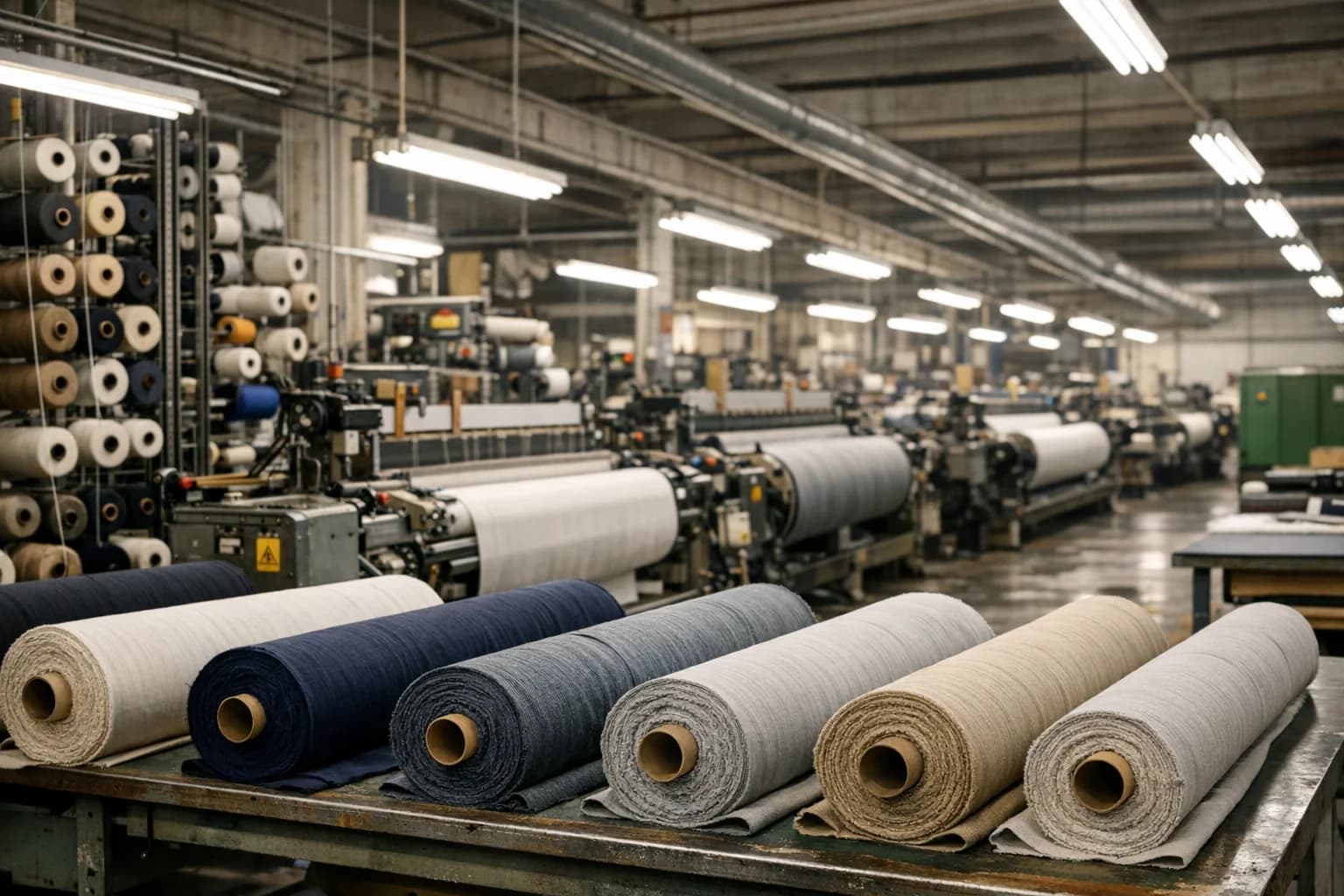
Scenario Metric References
| Metric | Value | Note |
|---|---|---|
| Global market value | $1.8–2.7T | |
| Annual growth | 4–7% | |
| AI market (2033–2035) | $20–60B | |
| AI CAGR | 25–35% | |
| Defect detection uplift | +20–30 pts vs. manual | |
| Downtime reduction | 30–50% with predictive maintenance | |
| Forecast error improvement | 10–20% with AI demand planning | |
| On-time delivery uplift | +3–8 pts with AI planning | |
| Inline QC latency | <120–250 ms edge inference | |
| Color/shade consistency | 20–40% fewer shade claims | |
| Price/markdown optimization | +150–300 bps margin on targeted SKUs | |
| Model uptime targets | 99.0–99.5% (edge/nearline) | |
| Pilot to first production line | 8–12 weeks | |
| Fabric defect target | -12% to -30% on recurrent inspection defect patterns | |
| Loom utilization target | +5% to +14% through downtime prediction and sequencing improvements |
Executive Summary: Textile and Apparel Market and AI Opportunity
The global textile and apparel value is estimated at $1.8–2.7 trillion depending on definitions, with annual growth of 4–7% projected beyond 2030.
The AI in textiles market is still only a few billion dollars, but is expected to jump to $20–60 billion by 2033–2035, compounding at roughly 25–35% annually.
AI adoption concentrates on factory-floor productivity (computer vision for defect detection), reliability (predictive maintenance and anomaly detection), and planning (demand and supply forecasts plus sequencing). Brands and mills also invest in generative design/CAD and recommender systems to shorten design-to-shelf time.
Digital Product Passport and ESG reporting requirements are accelerating traceability and data capture across mills and suppliers.
Fastest-growing applications
- Quality inspection (fabric defect detection, color matching, surface analysis)
- Predictive maintenance (anticipating machine failures)
- Supply chain / inventory optimization and demand forecasting
- Product personalization and flexible manufacturing (especially in fashion and apparel)
- Generative design/CAD for patterns, colorways, and trims with instant manufacturability checks
Direct impacts for production-focused textile businesses
- Raise fabric defect detection accuracy from about 60–70% manual inspection to 90%+, significantly reducing scrap and rework.
- Predictive maintenance cuts unexpected failures by 30–40% and unplanned downtime by 30–50%, while reducing maintenance costs by 20–25%.
- Process optimization reduces energy and chemical consumption by meaningful single digits (e.g., 5–10%), improving margins and sustainability scores.
- Demand forecasting + assortment recommendations reduce stockouts and overproduction, protecting margin and working capital.
AI technology toolkit for textile plants
- Computer vision with defect libraries (weaving, knitting, printing, dyeing, finishing) and spectral/color analysis for shade consistency.
- Time-series and multivariate anomaly detection for predictive maintenance, spindle health, and vibration/temperature drift.
- Optimization and simulation (digital twins) for recipe tuning, line balancing, and energy/steam load shifting.
- Demand forecasting + reinforcement learning for allocation and replenishment; recommender systems for assortments and sizing.
- Generative models for pattern ideation and CAD-assisted manufacturability scoring; LLM copilots for SOP guidance and shift handovers.
- Planner copilots for allocation and merchandising decisions that expose constraints, risks, and confidence scores.
Operating model, governance, and MLOps foundations
- Latency/SLA design: inline QC targets <120–250 ms; planner APIs tolerant of minutes; uptime targets 99.0–99.5% with alerting to OT + IT.
- Data quality: standard defect taxonomies, labeling SOPs with dual-review QA, and periodic re-labeling to counter drift.
- Shadow mode → HITL → assisted → autonomous rollout pattern, with rollback and version pinning for models and recipes.
- Monitoring across precision/recall, drift, latency, anomaly rates, and operator override rates; automated retraining triggers with audit trails.
- Deployment patterns: edge for low latency and data residency, cloud for heavy training; secure connectivity via VPC/privatelink and role-based access; PII minimization and buyer-audit readiness.
Why Veni AI is the right partner
- Textile-grade computer vision and predictive maintenance accelerators with prebuilt defect and anomaly templates across weaving, knitting, dyeing, finishing, and printing lines.
- End-to-end delivery: sensors/PLC integration, data engineering, labeling QA, model development, MLOps, operator UX, and change management with multi-plant rollout playbooks.
- Governance-first: data residency, access controls, audit trails, and compliance with EU/UK data rules and buyer audits; supports VPC/privatelink connectivity and on-edge deployment where data must stay on site.
- MLOps and monitoring baked in: drift/anomaly/latency monitoring, canary + shadow mode rollouts, versioned models with rollback, and SLA-aware alerting for uptime and precision/recall.
- Secure + compliant delivery: PII minimization, role-based access, segregation of duties, and incident playbooks aligned to OT + IT requirements.
- Rapid pilots (8–12 weeks) that quantify savings, then scale with reusable components, training for operators/planners, and knowledge transfer to internal teams.
We pair factory-floor CV/NLP experience with structured change management, ensuring new models land safely: start in shadow mode, keep humans-in-the-loop, and move to assisted then autonomous operations once KPIs stabilize.
Pilot-to-scale confidence
For textile manufacturers who want to stay competitive over the next 3–5 years, AI-powered quality, maintenance, and planning systems are no longer optional R&D. They are rapidly becoming the new standard, especially among large Asia-based players and technical textile producers.
Global Textile and Apparel Market Outlook and Demand Drivers
A rapid overview of market size, regional distribution, and macro trends.
Market size
- According to AHK (German Chamber of Commerce Abroad), the global textile market was about $1.84 trillion in 2023, with 7.4% revenue growth projected for 2024–2030.
- The global apparel market is about $1.7 trillion and is expected to reach $2.6 trillion by 2025, roughly 2% of world GDP.
- Some research estimates textile + apparel at about $2.6 trillion in 2023 and above $4 trillion by 2033.
- Technical textiles (automotive, medical, protective) show faster growth and higher margin, intensifying automation and AI investments.
Regional view
- Asia-Pacific (China, India, Bangladesh, Vietnam, etc.) holds the largest share in production and consumption; some reports cite 40–45%.
- The European Union is a major apparel import market (EUR 191 billion in 2022).
- Turkey is among key exporters to countries like Germany, known for mid-to-high quality, fast delivery, and flexible manufacturing.
- Nearshoring to Europe/MENA drives investments in digital, modular, and AI-enabled factories for shorter lead times.
Macro trends
- Cost pressure: wage increases and energy costs compress margins, accelerating automation and AI investment.
- Sustainability pressure: the sector contributes about 5% of global carbon emissions; as of 2024, roughly 65% of producers adopt sustainability-focused practices.
- Demand volatility: fast fashion and uncertain demand increase inventory and planning risk; AI for forecasting and planning is growing.
- Traceability and compliance: incoming regulations (Digital Product Passport, ESG disclosures) increase demand for data capture and AI-enabled anomaly checks.

AI in Textiles and Apparel: Market Size, Growth, and Adoption
Estimates vary across research firms, but they all point to the same trend: a small yet strategic market growing rapidly.
Adoption is pulled by tangible ROI on quality and uptime, and pushed by brand/retailer demands for traceability, compliance, and faster assortment refresh.
2.1 Market size and growth
- Market.us: $2.4B in 2023 → $21.4B in 2033; 2024–2033 CAGR 24.6%.
- Another consultancy report: $2.64B in 2024 → $43.8B in 2034; about 32.4% CAGR.
- Towards Chemical & Materials: $4.12B in 2025 → $68.4B in 2035; 32.45% CAGR.
- Growth is strongest in computer vision, predictive maintenance, energy optimization, and generative design/CAD copilots.
2.2 Application breakdowns
- Production / factory floor: predictive maintenance, quality inspection (fabric, yarn, coating, printing), process optimization (parameter tuning, recipe optimization, energy management).
- Supply chain and planning: demand forecasting, inventory optimization, supplier risk analysis, dynamic procurement.
- Product and customer: product design, trend forecasting, personalization and sizing recommendations, price optimization.
- Share by application (around 2024): quality inspection holds the largest share at 30%+; predictive maintenance is among the fastest-growing segments; supply chain and personalization rapidly increase in importance for large brands.
- Data governance, MLOps, and on-edge/near-line inference are now key buying criteria to pass factory audits and IT requirements.
Despite different methodologies, all sources describe a niche technology market growing 8–15x within a decade. This creates a meaningful early-mover advantage for textile manufacturers.

High-Impact AI Use Cases in Textile Manufacturing
The use cases delivering the highest impact on the production floor, with typical outcomes.
3.1 Automated quality inspection and fabric defect detection
Traditional fabric inspection relies on human vision. It is labor-intensive, time-consuming, and highly sensitive to operator fatigue.
Computer vision and deep learning systems scan fabric surfaces with high-resolution cameras and detect weaving and cutting defects, missed stitches, holes, lines, stains, and color deviations in real time.
Advanced setups combine RGB + hyperspectral imaging for shade control, and edge AI for low-latency detection directly on the line.
Segmentation models (U-Net variants, Mask R-CNN) isolate defect regions for precise cut-out decisions; spectral/Delta-E checks monitor shade consistency inline.
- Manual inspection accuracy is about 60–70%, meaning 20–30% of defects are missed.
- Well-trained models reach 90%+ accuracy across many defect types.
- Some real-time systems detect 40+ defect types at 60 m/min line speed with over 90% accuracy.
- Studies in 2024–2025 report 80–95% accuracy even on complex patterns.
- Color consistency and print registration checks reduce shade claims and rework in apparel supply chains.
- Typical inline inference latency targets: <120–250 ms per frame at the edge to keep up with line speed.
- Code example (Python): `defects = yolo_model.predict(fabric_frames)`.
- Higher first-pass quality and lower scrap and rework costs.
- Fewer returns and customer complaints.
- Less dependence on individual operators and easier scaling.
- Digital traceability: flagged defects are linked to rolls/lots for faster root-cause analysis.
- Shadow-mode then HITL acceptance before auto-stop reduces false positives while building trust.
3.2 Predictive maintenance and equipment efficiency
Textile production lines often run 24/7; most downtime stems from unplanned failures and improper maintenance.
Sensor data (vibration, temperature, current, speed, tension, etc.) is collected; machine learning learns normal patterns and flags deviations early.
Combining anomaly detection with contextual data (order type, material, environmental conditions) reduces false positives and prioritizes the right interventions.
Models segment by asset class: spinning frames, looms, dyeing lines, tenter frames, stenters, and knitting machines each have distinct signatures and failure modes.
- About 40% reduction in unexpected equipment failures.
- Around 25% savings in maintenance costs.
- 30–50% reduction in unplanned downtime.
- Better spare-part planning through predicted time-to-failure and MTBF insights.
- Condition-based maintenance intervals tuned per machine criticality and utilization.
- Higher OEE.
- Improved on-time delivery performance.
- More rational spare part and maintenance team planning.
- Safer operations by detecting hazardous conditions earlier.
- Shadow alarms + HITL validation before auto-stop reduce nuisance trips.
3.3 Process optimization and efficiency
Processes such as yarn count, weave patterns, knitting parameters, dye recipes, and fixation temperature-time profiles include many variables; finding optimal combinations manually is difficult.
AI analyzes large volumes of process data to identify parameter combinations that maximize yield and quality, and conditions that increase energy or chemical use.
Digital twins simulate recipe and parameter changes virtually before deployment on the line, reducing experiments and waste.
Reinforcement learning or Bayesian optimization can tune setpoints within guardrails; OT constraints (safety, emissions, dye lot integrity) stay hard-coded.
- Digital twin models allow recipe and setting tests in a virtual environment, cutting trial-and-error time.
- Higher production speed and fewer stoppages.
- Lower energy, water, and chemical usage for the same quality.
- Automated setpoint recommendations reduce operator variability on critical machines.
- Inline chemical dosing optimization lowers variance across lots.
- Reduced operator dependence.
- Know-how becomes less person-dependent.
- More stable quality across shifts and product variants.
- Guardrailed automation: HITL approve → assisted → autonomous once stable.
3.4 Planning, scheduling, and capacity utilization
In complex production environments, optimizing the order portfolio, machine park, and shift plan together is challenging.
Advanced analytics evaluates priorities and delivery dates to recommend which orders should run on which lines and in which sequence.
AI planners factor in changeover times, dye/finish compatibility, and operator skills to minimize idle time and overtime.
Hierarchical and time-series forecasting feeds allocation, while reinforcement learning or MILP optimizers propose schedules under constraints.
- Higher on-time delivery rates.
- Less overtime and fewer urgent loadings.
- Higher line utilization and fewer bottlenecks.
- Better promise-to-ship reliability for brand customers.
- Tighter S&OP: linking demand signals to weaving/knitting/dyeing capacity decisions.
3.5 Energy efficiency and sustainability
Dyeing and finishing, washing, drying, steaming, and fixation consume significant energy and water.
AI-driven energy management analyzes consumption data to detect anomalies and recommend load balancing and optimal temperature and duration settings.
Anomaly detection on steam and compressed air networks prevents leaks and captures immediate savings.
- 5–10% energy savings.
- Meaningful reductions in carbon footprint.
- Improved compliance with regulations such as the EU Green Deal.
- More predictable utility demand and reduced peak charges.
3.6 Intelligent design, CAD, and assortment planning
Generative models accelerate ideation of patterns, colorways, and trims; CAD-integrated AI checks manufacturability, fabric constraints, and cost impacts early.
Demand forecasting plus recommender systems guide which styles, colors, and sizes to buy or produce per channel and region.
Marker optimization and nesting algorithms reduce fabric waste in cutting rooms, linked to CAD and PLM.
- Shorter design-to-shelf cycles and fewer sample rounds.
- Higher full-price sell-through via size curves and channel-specific assortments.
- Lower overproduction risk and better working-capital turns.
- Waste reduction via optimized marker making and cut planning.
- Closer alignment between design, sourcing, and manufacturing constraints.
- Data-driven line planning with rapid A/B testing of virtual samples.
- Copilots for planners and designers to compare CO2/cost/lead-time scenarios before lock.
3.7 Supply chain, traceability, and risk
End-to-end visibility is increasingly demanded by brands and regulators; AI helps reconcile data from suppliers, logistics, and production to surface anomalies and risks.
Computer vision and RFID/IoT signals are combined to verify labels, materials, and process steps for digital product passport readiness.
Supplier risk signals (OTIF, quality escapes, ESG flags) feed allocation and dual-sourcing decisions; blockchain or signed events support chain-of-custody where required.
- Reduced chargebacks and compliance penalties.
- Faster root-cause analysis when quality issues arise in downstream stages.
- Scenario planning for supplier disruptions and logistics delays.
- Tighter SKU/assortment decisions per channel with better availability and lower working capital.
3.8 Pricing, allocation, and planner copilot
Dynamic pricing and markdown optimization balance margin and sell-through for volatile styles while protecting brand price corridors.
Planner copilots summarize supply signals, demand shifts, and capacity constraints, recommending allocations by channel/region/SKU with explainability.
- +150–300 bps margin lift on targeted SKUs through optimized markdown cadence (range varies by category and seasonality).
- Better clearance planning with lower residual inventory.
- Assortment decisions informed by size curves, returns, and localized demand signals.
- Shadow mode for pricing recommendations before activation; track delta vs. business-as-usual.
- What-if simulations showing margin, sell-through, and service-level impact before approval.

Quantified Benefits and KPI Impact
Quality inspection (fabric defect detection)
- 20–30% improvement in defect detection versus manual inspection.
- Some systems detect 40+ defect types with 90%+ accuracy.
- Meaningful reductions in customer complaints and returns (company-specific variation).
- Shade and print control reduce dye-house rework and seconds by low double digits.
- Inline latency targets: <120–250 ms to keep up with 40–80 m/min lines.
Predictive maintenance
- 30–40% reduction in unexpected failures.
- 20–25% reduction in maintenance costs.
- 30–50% reduction in unplanned downtime (up to 48% in some cases).
- Reduced overtime and weekend interventions by stabilizing maintenance windows.
- MTBF visibility improves spare-part planning and vendor negotiations.
Process optimization and energy
- 5–10% reduction in energy consumption per unit.
- 3–5% improvement in scrap and rework rates, with multi-million dollar impact at scale.
- Lower chemical and water usage in dyeing/finishing without quality loss.
- 1–3% yield uplift on critical recipes through setpoint optimization.
Planning and inventory
- 10–20% improvement in demand forecast error (industry-level examples).
- Higher inventory turns and service levels.
- Better commitment accuracy to brand customers, reducing penalties.
- +3–8 pts on-time delivery when scheduling is AI-assisted.
Design and assortment
- Fewer sampling rounds and faster design-lock reduce calendar time by weeks.
- Higher full-price sell-through via data-driven size curves and assortment decisions.
- Lower overproduction reduces write-offs and improves cash conversion.
- 1–3 pts margin improvement via smarter markdown/price optimization on targeted SKUs.
With the right setup, AI delivers a multiplier effect that improves both cost and revenue at the same time.

Implementation Challenges, Data Gaps, and Risk Controls
A 2025 study at the ITMF & IAF conference with 33 senior textile executives summarizes the main barriers to AI adoption as follows:
Mitigating these requires disciplined data work, transparent models, and continuous monitoring rather than one-off pilots.
Inline QC requires tight latency budgets; shadow mode + HITL review reduce false positives before automation.
Primary barriers
- Digital maturity and data gaps: machine data is often not collected or not standardized.
- Investment cost and ROI uncertainty: especially for SMEs, the initial investment appears high and benefits are hard to quantify.
- Shortage of qualified talent: combined OT, IT, and data science skills are scarce.
- Change management: concerns among operators and middle managers about job loss.
- Data governance and security: plant networks, PLCs, and vision systems must comply with IT/infosec and buyer audits.
- Labeling quality: inconsistent defect taxonomies and SOP drift reduce model precision/recall.
Additional technical risks
- Wrong model or algorithm choice → high false positive/false negative rates.
- Model neglect → accuracy degrades as processes change.
- Overdependence on vendors (black-box solutions).
- Lack of MLOps and monitoring → drift goes undetected, eroding ROI.
- Edge/latency constraints ignored → inspection systems may not keep up with line speed.
- Insufficient HITL/QA loops → undetected label noise and slow model recovery.
Beyond technology selection, project management, internal capability building, and change management are decisive for success.
Phased AI Execution Roadmap for Textile and Apparel
A business-focused, actionable framework: start with quick-win pilots and move toward scalable infrastructure.
Each phase should include model monitoring (drift, accuracy, uptime), data quality checks, and clear ownership across OT/IT/production.
Phase 1 - Digital infrastructure and data readiness
- Select the highest-impact lines and machines (e.g., spinning/weaving/knitting + dyeing/finishing).
- Plan sensor and data collection investments (PLC integrations, vibration/temperature sensors, energy meters).
- Collect data in a central platform (data lake or time-series database + dashboards).
- Implement data governance: access controls, retention policies, labeling standards, and audit logs aligned to buyer requirements.
- Define defect taxonomies, labeling SOPs, and QA sampling plans for CV datasets; set latency/SLA expectations with OT.
Phase 2 - Quick-win pilots and validation
- Fabric defect detection PoC: deploy camera-based inspection on a selected line and quantify missed defects and savings versus manual inspection.
- Predictive maintenance pilot: collect sensor data on a few critical machines and build an early-warning model; prevent 1–2 critical failures to prove ROI.
- Work with external vendors but assign at least one internal business owner and one data/automation lead.
- Stand up MLOps basics: versioning, CI/CD for models, dashboards for precision/recall and alert routing to maintenance/quality teams.
- Run shadow mode + HITL review for QC and maintenance alerts before auto-stop; agree on SLA/latency for inline inspection (<250 ms).
Phase 3 - Scale and integration across plants
- Roll out automated quality inspection to additional lines and fabric types.
- Expand predictive maintenance to the entire critical machine park.
- Develop additional analytics models for energy and process optimization.
- Enhance ERP/MES planning and scheduling with an AI layer.
- Integrate with traceability systems and digital product passport requirements; expose metrics to customer portals.
- Implement continuous monitoring for drift, latency, uptime; add rollback/versioning and blue-green or canary for model releases.
- Operator training and change management to shift from assisted to autonomous modes with clear SOP updates.
- First-pass quality and scrap.
- OEE and unplanned downtime.
- Energy and chemical consumption per unit.
- On-time delivery rate.
- Model precision/recall, alert acceptance rate, and retraining cadence.
- Model uptime/SLA adherence and latency vs. target.

Leadership Recommendations and Execution Priorities
- Position AI investments as a core competitive strategy, not a side project.
- Start small but design for scale: expand proven models across other lines.
- Prioritize in the short term: quality inspection and predictive maintenance; mid term: process optimization and energy management; long term: planning and personalization.
- Treat data and talent as strategic assets: define standards and build a core internal team.
- Demand transparency and knowledge transfer from vendors; avoid black-box dependency.
- Mandate governance and MLOps from day one: monitored models, clear ownership, and incident playbooks.
- Select partners who can integrate OT/IT, ensure compliance, and deliver measurable pilots within 8–12 weeks.
- Set explicit SLAs for uptime/latency (e.g., QC <250 ms, 99–99.5% availability) and rollback plans before enabling full automation.
Sources and Further Reading
1.1 Market size and industry outlook
- AHK – German–Egyptian Chamber of Commerce | Factsheet Textile & Clothing Industry (global/regional textile & apparel, EU imports)https://aegypten.ahk.de/en/content/download/80073/1100475?version=3
- Custom Market Insights | Global Textile and Apparel Market 2024–2033https://www.custommarketinsights.com/report/textile-and-apparel-market/
- Grand View Research | Textile Market Size, Share & Trends | Industry Report, 2033https://www.grandviewresearch.com/industry-analysis/textile-market
- Spherical Insights | Textile and Apparel Market Size, Share, Trends and Insighthttps://www.sphericalinsights.com/our-insights/textile-and-apparel-market
- Nivesh Mitra (UP Government, India) | Global textile and apparel trade (export value)https://niveshmitra.up.nic.in/Textiles.aspx
- Rawalwasia (industry blog) | Revolutionizing Textile Innovations in the Modern Industryhttps://rawalwasia.in/textile-innovations-the-modern-textile-industry-2024/
1.2 AI in textiles: market size and trends
- Market.us | AI in Textile Market Size, Share, Trends | CAGR of 24.6%https://market.us/report/ai-in-textile-market/
- Towards Chemical & Materials | AI in Textile Market Size to Hit USD 68.44 Bn by 2035https://www.towardschemandmaterials.com/insights/artificial-intelligence-in-textile-market
- Yahoo Finance | AI in Textile Market Size to Worth USD 68.44 Billion by 2035https://finance.yahoo.com/news/ai-textile-market-size-worth-081800362.html
- Market Techie | AI in Textile Market 2025–2034: Growth, Trends, and Leadinghttps://www.markettechie.com/ai-in-textile-market/
- Cervicorn Consulting | Artificial Intelligence in Textile Market – Market Segmental Analysishttps://www.cervicornconsulting.com/artificial-intelligence-in-textile-market
1.3 Fabric defect detection, quality control, production
- Wiley / Hindawi | Fabric Defect Detection Using Computer Vision (2020)https://onlinelibrary.wiley.com/doi/10.1155/2020/8189403
- Wiley / Hindawi | Fabric Defect Detection in Textile Manufacturing: A Survey of the State of the Art (2021)https://onlinelibrary.wiley.com/doi/10.1155/2021/9948808
- Nature Scientific Reports | Real-time detection of fabric defects based on an improved Elo rating algorithm (2025)https://www.nature.com/articles/s41598-025-17747-y
- SAGE Journals | Fabric defect detection using AI and machine learning for lean and automated manufacturing of acoustic panels (2024)https://journals.sagepub.com/doi/10.1177/09544054231209782
- Advantech (case study) | AI Defect Inspection for Textile (2019)https://www.advantech.com/en/resources/case-study/ai-defect-inspection-for-textile
- Robro Systems (technical textiles) | How AI is Reshaping the Technical Textile Industry's Quality Control (2025)https://www.robrosystems.com/blogs/post/how-ai-is-reshaping-the-technical-textile-industry-s-quality-control
- Indian Textile Magazine | It is time for AI Computer Vision to detect Fabric defects (2025)https://www.indiantextilemagazine.in/it-is-time-for-ai-computer-vision-to-detect-fabric-defects/
- EasyODM (manufacturing blog) | AI In Textile Manufacturing: Enhancing Quality Control (2024)https://easyodm.tech/ai-in-textile-manufacturing/
1.4 Predictive maintenance, production, energy efficiency
- WarpDriven.ai | AI Predictive Maintenance in Textiles 2025https://warpdriven.ai/en/blog/industry-1/ai-predictive-maintenance-textile-machinery-guide-178
- Global Textile Times | Predictive Maintenance for Textile Machinery Using IoT (2025)https://www.globaltextiletimes.com/uncategorized/predictive-maintenance-for-textile-machinery-using-iot/
- Ultralytics | The future of textile production with AI-driven manufacturing (2026)https://www.ultralytics.com/blog/the-future-of-textile-production-with-ai-driven-manufacturing
- Technical Textiles Innovation / ITMF | AI in the Textile Industry (2024 issue) – PDFhttps://www.itmf.org/images/dl/articles/2024/Technical-Textiles-Innovation-October-December-2024-Issue.pdf
- ITMF – International Textile Manufacturers Federation | AI in the Textile Industry (technical PDF)https://www.itmf.org/images/dl/articles/2024/AI-in-the-Textile-Industry_Technical-Textiles-Innovations.pdf
- IJRASET (academic) | Applying AI for Future Business Models in the Textile and … (2025)https://www.ijraset.com/research-paper/applying-ai-for-future-business-models-in-the-textile
- TTP / iVGPU (academic) | AI-integrated Predictive Maintenance (PDF)https://ttp.ivgpu.com/wp-content/uploads/2025/12/419_51.pdf
- ITMF Conference 2024 | AI & digital textile sessionshttps://www.itmf.org/conferences/previous-conferences/itmf-conference-2024
Additional standards and market references (2024-2026)
- ITMF | International textile statisticshttps://www.itmf.org/statistics/
- WTO | Trade statistics resourceshttps://www.wto.org/english/res_e/statis_e/statis_e.htm
- ILO | Textiles, clothing, leather and footwear sector resourceshttps://www.ilo.org/global/industries-and-sectors/textiles-clothing-leather-footwear/lang--en/index.htm
- OECD | Due diligence guidance for garment and footwear supply chainshttps://www.oecd.org/en/publications/oecd-due-diligence-guidance-for-responsible-supply-chains-in-the-garment-and-footwear-sector_9789264290587-en.html
Factory Owner Decision Playbook for Textile Plants
Decision support for leadership teams evaluating where to start, how to measure value, and how to de-risk rollout.
High-intent search queries this page targets
- AI for textile fabric inspection
- How to improve loom efficiency with predictive analytics
- Machine vision defect detection for textile production
- AI-based textile production planning and scheduling
90-day pilot KPI set
- Defect density per meter by loom and product variant.
- Loom uptime, micro-stop patterns, and mean recovery time.
- On-time order fulfillment by product family and lead-time bucket.
- Rework and quality hold rates linked to specific process windows.
- Planning error reduction versus baseline demand forecast.
Investment and payback checkpoints
- Pick one high-volume fabric family to isolate controllable quality economics.
- Track gains at both process level (downtime/defect) and commercial level (delivery reliability).
- Codify operator feedback into model retraining priorities each production cycle.
- Scale only after proving gains in both quality and planning responsiveness.
For most plants, value appears fastest when one quality KPI and one throughput/cost KPI are governed together under a single pilot owner.

Production Data and Integration Blueprint for Textile Operations
Operational architecture required to keep model outputs reliable in production, not just in proof-of-concept environments.
Systems that must be connected first
- Machine telemetry from looms, warping, and finishing lines.
- Vision inspection stations and quality grading outputs.
- MES/ERP for order priorities, lot tracing, and delivery commitments.
- Maintenance logs and spare-part constraints for critical assets.
- Demand and merchandising signals for planning horizon alignment.
Model risk and governance requirements
- Define quality-critical defect classes that always require human confirmation.
- Monitor model drift by style changes, raw material variance, and seasonality.
- Use shift-level adoption dashboards to stabilize AI-assisted operating behavior.
- Keep versioned process thresholds linked to product family and customer spec.
Scale-up criteria before multi-site rollout
- Pilot results sustained across at least two shifts and multiple SKUs.
- Delivery reliability improves without hidden quality tradeoffs.
- Inspection and planning teams adopt common decision protocol.
- Leadership validates net margin impact after full cost allocation.
Treat data quality, model lifecycle controls, and operator adoption as one integrated system; scaling only one layer usually destroys ROI.
Want to adapt this scenario to your factory?
Let's collaborate on data readiness, pilot selection, and ROI modeling.