01
What Qernel does
Classifies wheat varieties from images, scores confidence, and surfaces quality proxy bands for protein, gluten, and handling decisions at operational speed.

Qernel combines computer vision, confidence-aware decision logic, and production dashboards to improve lot acceptance, blend stability, and operational uptime in wheat and flour plants.
If you operate a flour mill, grain storage network, or wheat procurement business, Qernel provides a practical AI layer for faster and safer decisions from intake to blend planning.
For plant owners, general managers, and quality leaders, Qernel links each prediction to confidence policy, audit logs, and action history so commercial decisions stay explainable.
Qernel is designed for staged deployment: pilot one line, validate business KPIs, and scale to multi-site operations without breaking existing quality and maintenance workflows.

Qernel Product Suite
Built for flour mills, wheat processors, and grain businesses that need higher throughput with lower quality risk.
From intake to blend control, Qernel combines visual classification, confidence thresholds, and reference quality mapping so your team can reduce spec drift, shorten decision cycles, and protect margin.
Product Positioning
Qernel is not a lab replacement. It is an operations intelligence layer that accelerates decisions, improves consistency, and helps leadership teams scale quality discipline across shifts and sites.
01
Classifies wheat varieties from images, scores confidence, and surfaces quality proxy bands for protein, gluten, and handling decisions at operational speed.
02
It does not fabricate chemistry measurements. It separates inferred class confidence from certified reference ranges to keep risk communication clear.
03
Lower quality drift, faster intake approvals, stronger intervention timing, and clearer accountability for quality and plant teams.
Capability Matrix
Each capability is designed to reduce ambiguity for operators while giving executives and quality leads measurable control over consistency, uptime, and traceability.
Purpose-tuned multi-class recognition for industrial wheat imagery, with transfer-friendly architecture for seasonal and supplier-level variability.
Swin Transformer V2
Predictions below policy threshold are routed to controlled review workflows instead of unsafe auto-acceptance, protecting procurement and blend decisions.
>= 0.60 Required
Accepted classes are linked to structured quality ranges and usage guidance so planners can balance quality targets against commercial constraints.
Genotype -> Quality Proxy
Server-side auth, rate limits, health checks, and rollback-ready releases support procurement, quality, and maintenance workflows without brittle operations.
Secure by Default
Connects process events, vibration history, and anomaly scores to expose failure risk early and reduce emergency downtime costs.
Up to -50% downtime potential
Structured event logs and timeline views provide full traceability for overrides, classifications, and approvals required by enterprise governance.
Full action trace
Execution Flow
Qernel architecture keeps decisions explainable and rollback-safe by separating inference, validation, enrichment, and action layers for both plant operations and executive governance.
01
Image intake from mobile or line camera, normalization, and device health validation before inference.
Edge capture + preprocessing
02
SwinV2 evaluates class probabilities and emits ranked genotype predictions with latency targets for inline use.
Azure endpoint + fallback
03
Top prediction is checked against policy threshold and routed to success or low-confidence workflow.
Policy engine
04
Validated prediction joins master variety table to provide quality proxy ranges and process notes.
Master variety database
05
Dashboard cards, alerts, and logs drive decisions while preserving audit trails and manual override context.
UI + observability
-20% to -35%
Quality variance target
-15% to -30%
Unplanned stop target
<120-180ms
Inline decision latency
First 60-90 days
Pilot value visibility
Single-site to multi-site
Scale model
Where Teams Apply It
Use cases are prioritized for measurable value in quality, throughput, procurement consistency, and reliability domains.
01
Classify incoming lots faster and route uncertain cases to review before they affect blend quality.
02
Combine class confidence and quality proxy ranges to reduce over-reliance on expensive high-protein lots.
03
Detect shifts in process signatures early and trigger corrective playbooks before spec breaches expand.
04
Surface early warnings for critical line assets by correlating anomalies with historical failure patterns.
05
Track supplier consistency and lot-level conformance trends to support purchasing strategy and contract governance.
06
Compare quality drift, response speed, and intervention patterns across plants to spread best practices faster.
Product Tour + Visual Context
Qernel UI lives inside a broader wheat value chain. The gallery combines product screens and operational context imagery.
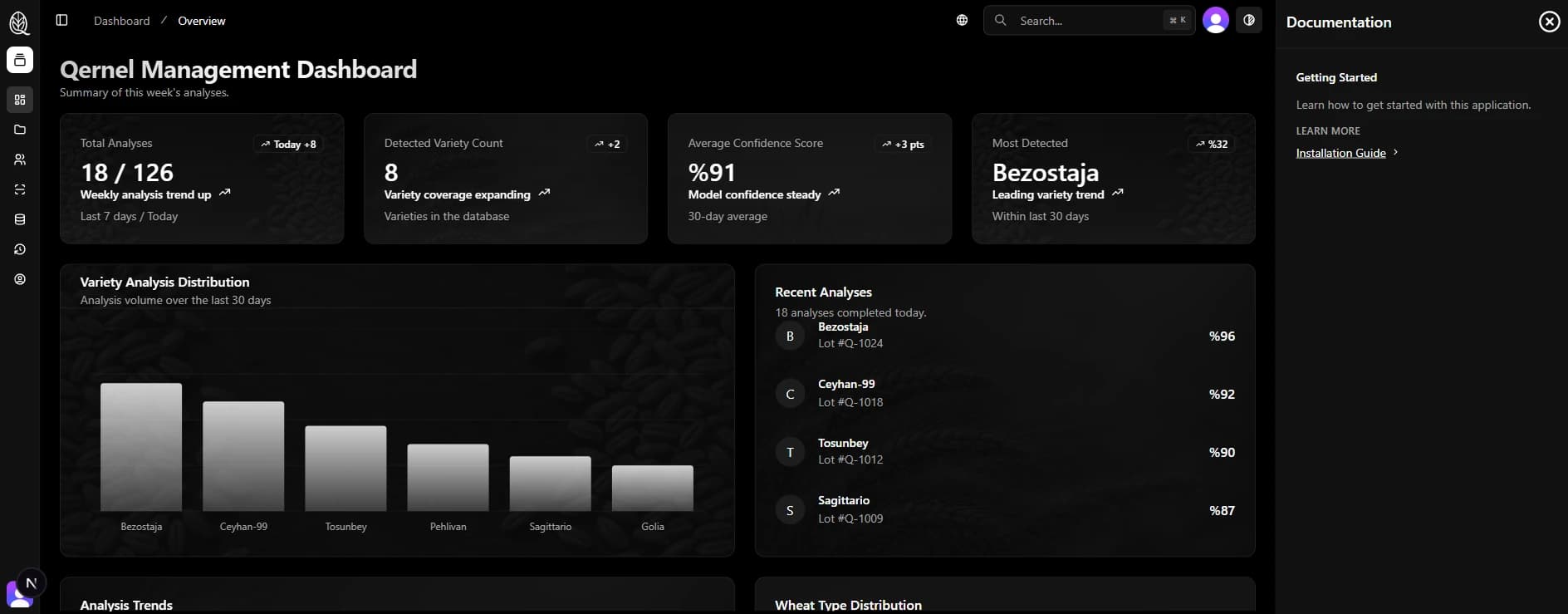
01
Dashboard Overview
Mission-critical metrics, activity streams, and fast access to analysis surfaces.
Technical and Academic Backbone
For due diligence, governance design, and literature-backed decision making, use our wheat scenario knowledge base as a board-ready reference layer.
End-to-end roadmap from field sensing to flour mill quality and maintenance operations.
Open ScenarioMarket references, disease detection literature, and milling-oriented AI adoption sources.
Open SourcesDeployment safety, HITL rollout strategy, drift monitoring, and rollback controls for production AI.
Open GovernanceFAQ
Short answers for technical, operational, and executive decision makers.
No. Qernel identifies genotype visually and maps validated predictions to certified quality ranges from a controlled reference database.
Low-confidence outputs are explicitly flagged and routed to review workflows, preventing unsafe auto-accept behavior.
Yes. Qernel is designed for secure API-level integration with dashboard, quality, storage, and maintenance systems.
Typical pilot windows are 8 to 12 weeks, followed by staged scale-out depending on data maturity and operator readiness.
It keeps structured logs, confidence context, operator actions, and versioned model-policy releases to support audits and rollback decisions.
Leadership can track intake decision cycle time, lot rework rate, quality drift trend, escalation frequency, and downtime-related intervention signals.
Your company retains ownership of operational data and decision outputs. Qernel supports policy-driven access controls and audit logs for enterprise governance.

Deploy Qernel with Veni AI
We tailor Qernel to your capture conditions, governance model, and operational cadence, then align rollout with measurable KPI targets from pilot to scale.
Executive-ready KPI tracking | Confidence-aware inference | Audit-friendly rollout